


CPA Rental Property: When You Need a Real Estate CPA vs. Bookkeeper (and How to Avoid Expensive Mistakes)
March 14, 2026Bookkeeping Software for Rental Property: 2026 Guide for Serious Landlords & Investors
April 8, 2026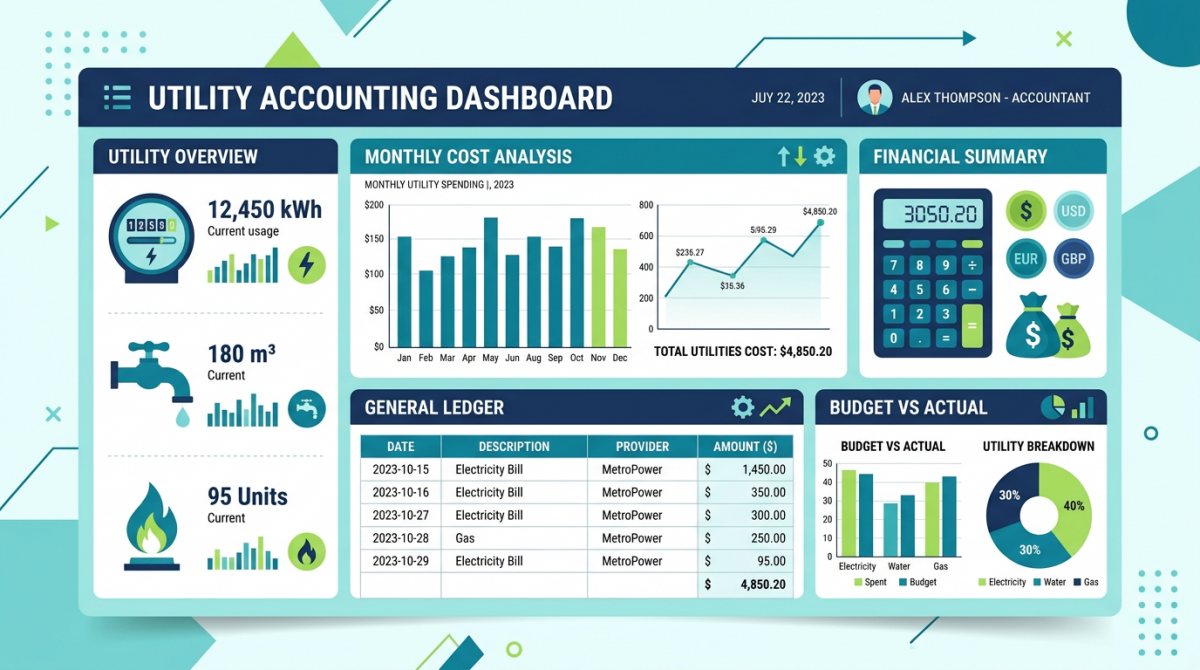
Utility Expense Management in Property Management
Key Takeaways
- Utility expense management is a core operational control function in property management, not clerical bill processing. Poor setup and monitoring lead to power shutoffs, angry tenants, and owners questioning expense control.
- Utility expense management is especially critical for enterprises and facilities with complex operations and multiple locations, where centralized oversight is essential for operational stability, cost reduction, and strategic planning.
- Centralizing utility invoices and usage data into a single system minimizes administrative overhead and reduces the risk of errors.
- Utility expense management supports informed decision making and a deeper understanding of utility expenses, enabling better cost control and strategic planning.
- Continuous monitoring and auditing are required to sustain savings and flag overcharges, duplicate bills, incorrect rates, and late fees before they impact the bottom line.
- A US-based Utilities Manager (or equivalent role) should own provider relationships and decision-making, supported by VAs or automation for data entry and processing.
- Centralizing utility data, actively auditing bills, and managing move-in/move-out workflows reduces overbilling, late fees, and legal risk.
- Utilities represent 10–30% of a building’s operating budget—making effective utility expense management a direct lever for NOI improvement.
- This article shows how to build a practical, property-management-focused program using 2026 tools and workflows.
Is Your Property Management Team Drowning in Utility Tasks?
It’s a Tuesday morning in August. Power gets shut off at a 120-unit community because the utility account never got transferred after a June move-out. Onsite staff scrambles to call the utility, calm residents, and explain the issue to ownership—time that should have been spent on leasing and service requests.
This wasn’t a maintenance failure. It was a breakdown in utility expense management and account administration.
Common pain points include thousands of utility bills, confusing rate structures, manual processes for move-ins and move-outs, and inconsistent communication with utility vendors. Many enterprises, especially large organizations and government agencies, struggle with disconnected utility data and managing multiple utility accounts, making it difficult to understand and control utility expenses effectively. Treating utilities like data entry—receive, enter, pay—guarantees missed errors, service interruptions, and unnecessary costs. Accurate and timely payment processing is essential for effective utility expense management, helping to reduce administrative overhead and improve financial oversight.
What Is Utility Expense Management in Property Management?
Utility expense management is the end-to-end process of setting up, monitoring, and paying for electricity, gas, water, sewer, trash, and internet/cable across all properties. It includes account setup and transfers, meter read verification, utility invoice capture and validation, dispute management, and reporting on usage and spend.
For multifamily portfolios, this often involves hundreds of active utility accounts across multiple states and providers. This is fundamentally different from simple utility bill management, which only focuses on paying invoices on time without deeper validation or oversight. Utility expense management provides the data and structure needed for informed decision making and a comprehensive understanding of utility expenses across the portfolio.
For portfolios using AppFolio, Yardi, or Buildium, utility expense management should integrate tightly into those platforms—not live in scattered spreadsheets.
Why Utility Expense Management Matters for Property Owners and Managers
Utility expenses are typically the second- or third-largest controllable expense category in a multifamily P&L, after payroll and repairs/maintenance. For enterprises, utility expenses often rank among the highest ongoing operational costs, making effective management essential for financial stability. According to the National Apartment Association, utilities represent 10–30% of a building’s operating budget.
The impact on financial performance is direct: a 5–10% reduction in utility spending across a 1,500-unit portfolio can materially increase property value at a 5–6% cap rate. Poor management leads to overbilling (vacant unit charges, wrong rate classes), late fees that compound monthly, and rework for accounting teams.
Utility reliability also affects resident satisfaction. Intermittent outages from account issues drive negative reviews and non-renewals. Lenders and investors increasingly require detailed historical utility data, making organized utility expense management a key advantage during due diligence.
Utility Expense Management vs. Simple Utility Bill Processing
Utility invoice processing pays bills. Utility expense management controls risk, cost, and resident experience.
Bill processing is reactive: invoices arrive, data is keyed in, payments are sent with minimal validation. Streamlined and accurate payment processes are a key component of utility expense management, reducing administrative overhead and ensuring financial oversight. Utility expense management is proactive: confirming accounts at move-in/move-out, verifying meter reads, challenging billing errors, and tracking consumption patterns.
Management includes oversight of service status—preventing shutoffs—not just ledger accuracy. Processing-only approaches lead to expensive mistakes: duplicate billing, wrong rate classifications, and unmonitored vacant usage running for months.
The Hidden Operational Risks of Poor Utility Management
The biggest risks aren’t just financial—they’re operational and reputational.
Risk Type | Example | Consequence |
|---|---|---|
Service Interruption | Account not transferred at lease turnover | Shutoff while unit is occupied |
Financial | Estimated reads never trued up | Persistent overbilling |
Legal/Compliance | Utilities lapse in occupied unit | Habitability violations |
Reputational | Repeated outages at same property | Owners question management competence |
Ghost accounts at closed properties continue generating charges. Orphaned accounts create billing responsibility confusion. Without consistent visibility into account status, these errors compound.
What Makes Utility Accounting Different from Clerical Work
A common but wrong assumption: utilities are “perfect for a VA” because they look like repetitive data-entry tasks.
The reality of dealing with US utility vendors:
- Long hold times and inconsistent internal notes
- Reps unfamiliar with multifamily master-billing or RUBS
- Confusing tariff structures that change without notice
- Rate changes applied incorrectly
Effective utility accounting requires judgment: knowing when a meter read doesn’t make sense, when to escalate a dispute, and how to push back against incorrect fees. This is relationship management with providers—not just entering numbers.
Offshore VAs can support the process, but oversight and decision-making must be led by someone with US utility context and authority.
Core Components of a Strong Utility Expense Management Program
A solid program is built on five pillars:
- Account Lifecycle Control: Standardized checklists for acquisitions, new construction, and dispositions—including final reads and closing unused meters
- Invoice Capture and Validation: Centralized inbox or EDI feeds, OCR/AI line-item parsing, rule-based checks before invoices hit A/P
- Usage Verification: Comparing consumption data against historical baselines, flagging spikes or drops
- Dispute Workflows: Documented steps for contacting providers, required documentation, follow-up tracking
- Reporting and Analytics: Monthly property-level utility P&L, cost per occupied unit, variance-to-budget dashboards. Centralized utility data allows leaders to compare performance across regions and identify which facilities operate most efficiently.
For organizations managing multiple facilities, specialized utility management and centralized data are essential for optimizing operational efficiency and compliance.
These components transform managing utility expenses from reactive bill-paying into proactive cost control.
Centralized Utility Data: The Foundation for Smarter Utility Management
Centralized utility data is the backbone of effective utility expense management for property management companies. By bringing together all utility invoices, usage data, and consumption patterns into a single, unified platform, organizations gain consistent visibility into their utility expenses across every property and account. This centralized approach streamlines utility bill management, making it easier to track payments, monitor trends, and quickly identify billing errors before they become costly issues.
With all utility data in one place, companies can move beyond reactive expense management and start leveraging actionable insights to optimize utility spending. Timely payments become the norm, reducing the risk of late fees and service interruptions. Centralized utility data also enables property managers to analyze consumption patterns, spot anomalies, and implement targeted cost control strategies that drive real savings.
By reducing manual processes and consolidating data, organizations free up staff to focus on high-value tasks that support business growth. Ultimately, a centralized approach to utility data management empowers companies to make informed decisions, improve accuracy, and continuously optimize their utility expenses for better financial performance.
The Role of a US-Based Utilities Manager (and How VAs Fit In)
Oversight first. Delegation second.
The Utilities Manager role should be US-based, understand how US utilities operate, own provider relationships, and make final decisions on disputes and escalations. Typical responsibilities include account setup for new properties, approval of high-variance bills, training internal teams, and overseeing AI/VA workflows.
VAs support the process by downloading bills, doing initial data entry when automation fails, gathering documentation, and updating trackers. The separation is clear: the Utilities Manager handles context-heavy decisions and calls; VAs and tools handle repeatable, well-documented tasks.
Building End-to-End Processes Around Move-Ins, Move-Outs, and Acquisitions
Most service interruptions and mis-billing happen at transition points.
Move-In Checklist:
- Confirm service dates with provider
- Verify meter is active
- Capture starting meter read
- Store confirmation numbers
Move-Out Process:
- Schedule final read
- Confirm end date and responsibility transfer
- Ensure no coverage gap
Acquisition Onboarding:
- List all existing accounts
- Confirm legal names and tax IDs
- Centralize bills into single platform
- Close orphaned accounts
Clear accountability matters: specify who owns each step, with deadlines and a simple status tracker accessible to operations and accounting.
Best Practices for Utility Expense Management
Adopting best practices in utility expense management is essential for organizations aiming to reduce costs, minimize risk, and maximize the value of their utility spending. One of the most effective strategies is to conduct regular audits of utility data and invoices, which helps uncover billing errors and identify new savings opportunities. Implementing a centralized utility data management system ensures that all utility expenses are tracked accurately and consistently, providing a solid foundation for effective expense management.
Engaging utility experts can also make a significant difference—these professionals can negotiate better rates with utility vendors and provide guidance on complex rate structures. Timely payments should be a top priority to avoid unnecessary late fees and maintain good standing with providers. Monitoring consumption patterns across properties allows organizations to pinpoint inefficiencies and target areas for improvement, while investing in energy-efficient technologies can further reduce operating costs and support sustainability goals.
By following these best practices—regular audits, centralized data, expert negotiation, timely payments, and proactive consumption management—companies can achieve effective utility expense management, reduce their operating costs, and enhance their overall financial performance.
Common Challenges in Utility Expense Management
Managing utility expenses is often a complex and time-consuming process, especially for organizations with multiple locations and a variety of utility vendors. One of the primary challenges is the sheer volume of utility invoices that must be processed and paid accurately each month. Manual processes can lead to errors, missed payments, and a lack of visibility into overall utility spending, making it difficult to control costs and optimize usage.
Billing errors are another common issue, as discrepancies in utility invoices can go unnoticed without proper oversight and expertise. Analyzing consumption data to identify trends and opportunities for improvement can be daunting, particularly when data is scattered across different systems or formats. Organizations may also struggle with limited internal expertise in utility management, further complicating efforts to manage utility expenses effectively.
To overcome these challenges, companies can leverage utility invoice processing software and other technology solutions to automate routine tasks, improve accuracy, and provide real-time insights into utility spending. By streamlining operations, increasing visibility, and tapping into specialized expertise, organizations can reduce costs, improve efficiency, and gain greater control over their utility expense management processes.
Technology, Automation, and AI in Utility Expense Management
In 2024–2026, effective utility management blends human oversight with automation—especially for portfolios using AppFolio, Yardi, or similar systems.
Invoice ingestion automation includes email scraping, portal downloads, and EDI feeds. AI-based line-item parsing breaks down charges and checks them against rules before they reach accounts payable. Custom workflows can route high-variance or first-bill invoices to the Utilities Manager for review.
Automation still needs guardrails. Periodic testing, human review of edge cases, and recalibration after rate changes remain essential.
Measuring Success: Metrics and Reporting Owners Actually Care About
Owners care about results, not process. Reporting must be clear and business-focused.
Key Metrics:
- Total utility cost per occupied unit per month
- Per-square-foot operating costs
- Year-over-year trendlines by property
- Service interruptions tied to account issues
- Billing disputes raised and resolved
- Late fees incurred and overcharges recovered
Present these in monthly or quarterly owner reports with short commentary explaining notable variances and corrective actions. This delivers actionable insights that demonstrate control.
Getting Started: Practical Steps to Improve Utility Expense Management This Quarter
You don’t need to overhaul everything at once. Focus on key changes over the next 90 days:
- Inventory all active accounts by property, provider, and service type
- Centralize invoices into a single digital repository
- Implement basic validation rules: flag unusually high usage, new fees, or duplicate invoices
- Assign clear ownership (or hire a Utilities Manager) and document move-in/move-out checklists
- Pilot automation on one or two providers, then expand once the proven process is stable
Quick wins—catching billing errors and stopping late fees—typically appear within 60–90 days. Deeper savings from analytics and efficiency projects emerge over 6–12 months as historical data accumulates.
Stop treating utility accounting like clerical work. It’s an operational control function that protects cash flow, reduces costs, and keeps residents satisfied.
FAQ: Utility Expense Management in Property Management
How is utility expense management different for multifamily vs. single-family portfolios?
Multifamily typically involves master meters, shared common-area accounts, and RUBS or submetering—with higher stakes when outages affect many residents at once. Single-family portfolios often have more tenant-responsible accounts but still require oversight at vacancy and turns. The principles of centralized data and strong oversight apply to both.
When should a property management company hire a dedicated Utilities Manager?
Once a company manages more than 500–700 units or has properties across 3–4 utility territories, a dedicated Utilities Manager becomes cost-effective. Frequent service interruptions, recurring late fees, or growing invoice volume signal that ad hoc handling no longer works.
Can smaller owners still benefit from formal utility expense management?
Absolutely. Even owners with 50–150 units benefit from consistent move-in/move-out checklists, centralized digital storage, and simple variance checks. Smaller operators have less buffer to absorb unexpected charges—catching one major billing error can justify the entire effort.
How long does it take to see results?
Quick wins like catching billing errors and stopping late fees appear within 60–90 days. Deeper savings opportunities from rate reviews and efficiency projects typically emerge over 6–12 months. Utility expense management is an ongoing control function, not a one-time project.
What data should we collect for long-term benchmarking?
Essentials include service address, meter numbers, rate schedule, start/end dates, billed usage, demand charges, line-item breakdowns, and occupancy data. For properties where heating and cooling dominate, capture weather data for normalized analysis. Consistent data from 12–24 months enables confident benchmarking.